Using the SPICES model to develop innovative teaching opportunities in ambulatory care venues
Article information

Trans Abstract
It is possible to begin new teaching opportunities in a variety of ambulatory care venues and design these teaching and learning programmes using the SPICES approach to curriculum reform. In an ambulatory care teaching programme it is possible to stimulate more student-centred learning and to move away from clinician-focused teaching. Opportunities for integrated learning and problem solving can be provided and an inter-professional approach fostered. Learning in the clinical context can be structured to meet both students' needs and curriculum requirements. Finally, opportunities for elective studies can be taken by students with a particular interest in a topic encountered. Developing a new teaching programme in an ambulatory care venue provides an opportunity to introduce elements of the SPICES approach to learning. The new programme created can be a model of innovative teaching in a medical school wishing to develop a revised undergraduate curriculum.
INTRODUCTION
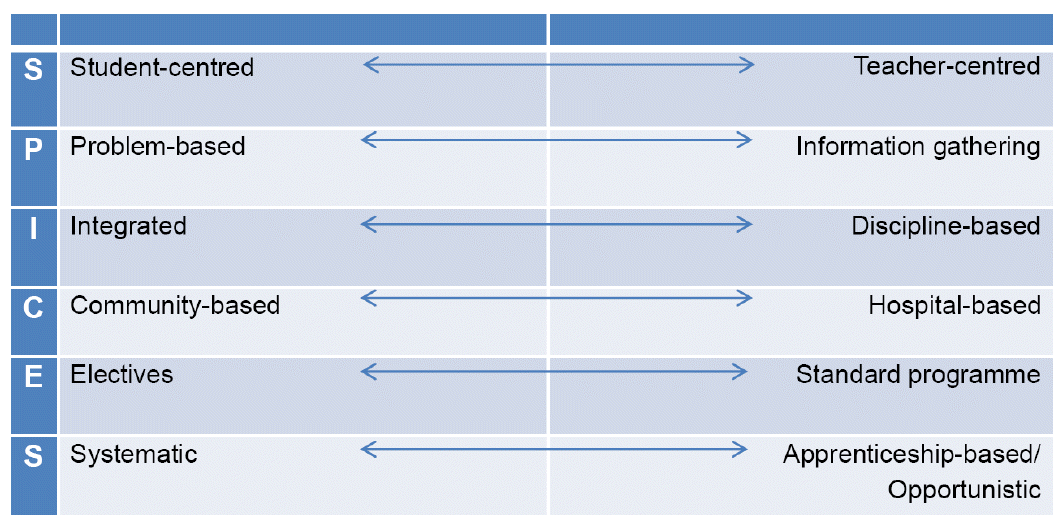
Thirty years after its original description, the SPICES model of educational strategies [1] remains a key tool for reforming and organising the undergraduate medical curriculum. The key elements promoted in the SPICES model, student-centred learning, problem-based learning,integrated or inter-professional teaching, communitybased education, elective studies, and a systematic or planned approach, are now widely shared and accepted[2]. Together these provide an alternative approach to a traditional curriculum with its teacher-centred, informationgathering, discipline-based, hospital-based, standardised programme and its opportunistic, apprenticeship-based learning (Fig. 1). Medical schools with a reformed curriculum have incorporated aspects of the SPICES approach to various extents.
“Ambulatory care refers to any place where patients attend healthcare facilities without being admitted as in-patients” [3]. Currently ambulatory care venues are under-recognised by medical schools as a teaching and learning resource. Arguments for introducing teaching opportunities in ambulatory care venues [4] include:
1) The duration of hospital in-patient stay has decreased due to the current move to providing more ambulatory-based patient care.
2) Core clinical problems are now more likely to beseen out-with the traditional teaching hospital. Day-care venues can be more appropriate for student learning.
3) “When implemented properly, ambulatory care education is uniquely suited to meet the needs of students, practicing physicians and most importantly the patient” [5].
4) Directives from governing bodies for medical schools or for licensing practitioners may also promote this change of emphasis.
VENUES FOR AMBULATORY CARE TEACHING
If we look at venues where ambulatory care teaching initiatives have been reported, we see how elements of the SPICES model have been used to create innovative teaching and learning programmes making the experience, on many occasions, preferable to conventional teaching with in-patients.
1. Traditional venues
In routine out-patient clinics a student-centred approach was introduced using structured logbooks to help students maximise their learning [4].
2. Additional venues
In those hospital venues less commonly used for undergraduate teaching and in regional healthcare venues, opportunities for inter-professional teaching and for experience of healthcare in the wider community setting were identified [6,7].
3. Innovative venues
Some schools have created dedicated teaching spaces and programmes. An Ambulatory Care Teaching Centre (ACTC) was used to deliver a student-centred programme with a systematic approach using systemsensitive volunteer patients. In this way students were enabled to integrate their learning with information acquired elsewhere [8,9]. In a regional Diagnostic and Treatment Centre (DTC) student learning was focussed on solving clinical problems encountered in community settings and opportunities were provided for student elective studies [7]. Finally a simulated out-patient clinic where students received tutor feedback on a video recording of their encounter with standardised patients also provided an example of student-centred learning [10].
USING THE SPICES MODEL
Medical schools wishing to provide new clinical teaching opportunities in an ambulatory care venue can be encouraged to use the SPICES model of educational strategies to create a programme with characteristics of a revised, undergraduate curriculum.
1. Student-centred learning
Student-centred learning can be promoted by the use of study guides [9] or structured logbooks [3]. These resources can direct students to learning outcomes related to the clinical problems being seen. A student-centred approach can be provided in the ACTC where tutors are free from the demands of patient care and interruptions. Students benefit from the unhurried environment, the personal tuition and from time to practise clinical or communication skills [8].
2. Problem-based learning
Study guides or logbooks can provide diagnostic or management problems for students to solve based on the core clinical problems they will encounter [7]. The emphasis is on problem-solving rather than information gathering.
3. Integrated or inter-professional learning
Integrated learning can be facilitated when students in a systems-based course attend a clinical teaching session using system-sensitive patients invited from a bank of patient volunteers. Students can be stimulated to integrate their learning by reflecting on clinical or theoretical information encountered elsewhere in the course [8]. Related information can also be made available in the session for reference or revision. Learning transfer is enhanced by providing tutors who teach in both dedicated teaching venues and routine clinical settings [9]. Inter-professional teaching is readily available in the Day Surgery Unit where students
see patients on their journey from pre-assessment, to surgery and post-operative recovery, so encountering a variety of healthcare professionals [4].
4. Community-based
Moving student teaching to venues in the wider community such as the DTC [7] or to community child development clinics [6], allows students to gain experience in a wider range of common healthcare problems often more appropriate for undergraduates and with patients who may be more accessible than those in the teaching hospital.
5. Elective
Introducing student elective opportunities in ambulatory care venues moves learning away from a standardised/uniform programme to one which gives students a choice of further study in areas of interest. A 4-week rotation through a variety of specialties in out-patient clinics; the clinical investigation and radiology units; nurse or therapist-led procedure clinics; and the day surgery unit were appreciated by students who selected this option [7]. Informally they reported an increased interest in rural-based practice as a result.
6. Systematic
Structured logbooks are the key to delivering a systematic approach to clinical teaching in ambulatory care settings. They can ensure that students see the required range of core clinical problems and focus on appropriate learning objectives. Opportunistic exposure to clinical cases is avoided by using system-specific patients selected from a bank of patient volunteers invited to the ACTC teaching session so ensuring that the clinical cases seen match the students’ current theoretical course [8].
CONCLUSION
The SPICES model of educational strategies remains as relevant today as 30 years ago wherever curriculum reform is required or where new approaches to teaching and learning are being introduced. Introducing new teaching opportunities in an ambulatory care teaching facility provides an opportunity to use the SPICES model to develop an innovative programme in a new location.It is possible to visualise a teaching programme or curriculum by plotting it on the SPICES spectrum and observing whether its use of any of the six strategies is more to one end of the spectrum than the other. Over time this position may change as further innovations are introduced.
In an ambulatory care teaching programme it is possible to stimulate more student-centred learning and to move away from clinician-focused teaching. Opportunities for integrated learning and problem solving can be provided and an inter-professional approach fostered. Learning in the clinical context can be structured to meet students’ needs and curriculum requirements. Finally, opportunities for elective studies can be taken by students with a particular interest in a topic.
Developing a new teaching programme in an ambulatory care venue provides an opportunity to introduce elements of the SPICES approach to learning. The new programme created can be a model of innovative teaching in a medical school wishing to develop a revised undergraduate curriculum.