Medical students’ and patients’ perceptions of patient-centred attitude
Article information

Abstract
Purpose
Patient-centred care can increase patient satisfaction and lead to better clinical outcomes for them, such as improved physical status and higher health-related quality of life. However, doctors’ and patients’ views on patient-centred attitude might differ and could be affected by culture and the community environment. To clarify the differences in primary care patients’ and senior medical students’ perceptions of medical students’ patient-centred attitude.
Methods
A total of 1,025 subjects—827 patients from primary care institutions and 198 fourth-year medical students from a medical college in South Korea—completed the Patient Practitioner Orientation Scale (PPOS). The students completed the self-reported questionnaire at the end of their clinical clerkship. Descriptive statistics, t-tests, and one-way analysis of variances were conducted in SPSS version 21.0.
Results
Firstly, sharing subscale scores were higher among patients than among medical students (students, 3.61 vs. patients, 3.76; p<0.001), but secondly, caring subscale scores were higher among medical students (students, 4.18 vs. patients, 3.82; p<0.001). Thirdly, PPOS total scores were higher among medical students (students, 3.90 vs. patients, 3.79; p=0.001). Finally, male students had the lowest sharing scores (F=6.811, p<0.001) and female students showed the highest PPOS total scores (F=5.805, p=0.001).
Conclusion
Significant differences between medical students’ and patients’ perceptions of medical students’ patient-centred attitudes suggest the necessity of educational efforts to overcome the gap between the groups.
Introduction
With the rapidly aging society and rising level of education, awareness of population health has increased. The development of the Internet and smart devices has afforded patients easy access to medical data and disease treatment methods through various channels. As a result, there has been a shift in the relationship between doctors and patients from relatively imbalanced to open and mutual [1]. Both awareness of the importance of patient-centred care and interest in the communication styles between doctors and patients are rising. Previous studies have shown that patient-centred attitude and good communication strengthen the doctor-patient relationship in dealing with illnesses, which in turn leads to better healthcare, patient satisfaction, patient adherence to treatment, and clinical outcomes [2,3,4,5,6,7]. Such results imply the need and appropriateness of changes in medical education. When medical students graduate from medical college to being full-fledged doctors, they must be able to cultivate good doctor-patient relationships in a patient-centred care climate. Medical students thus require education programs reinforcing communication and empathy skills and patient-centred attitude. However, to develop an effective program on this topic, there is a need to clarify current perceptions of patient-centred care.
Most previous studies have focused on the differences in patient-centred attitude of the students by gender or work experience and excluded the core factor—namely, the patients themselves—or focused on correlational results between career plans and influence of evaluations of psychosocial and biomedical issues [8,9,10,11]. Thus, we have found it difficult to obtain appropriate information for use in educational programs to narrow the gap between medical students’ and patients’ perceptions of patient-centred attitude. As a first step, we focused on analyzing the extent of the gap between patients’ assessments of medical students’ patient-centred attitude and medical students’ self-assessments, and discussed preliminary actions for building more appropriate doctor-patient relationships.
Subjects and methods
1. Participants
In 2005 and 2010, we administered a questionnaire on patient-centred attitude to patients from primary care institutions (family medicine clinics) in Seoul and Gyeonggi province, South Korea. We excluded patients aged 20 years or younger and those deemed unable to complete the self-reported questionnaire because of health problems (e.g., visual or mental problems). In 2006 and 2009, fourth-year medical students from a college of medicine in South Korea completed the same survey as the patients (Table 1). The reason we introduced gaps between data collection times was to obtain an overall picture of patients’ and students’ Patient Practitioner Orientation Scale (PPOS) scores rather than the PPOS scores at a particular point in time. The students completed the questionnaire survey at the end of their clinical clerkship. After the survey, we excluded questionnaires that were incomplete. Ultimately, we analyzed 827 surveys from the patients and 198 from the medical students.

Distribution of Subjects
We assessed patient-centred attitude using the PPOS [12]. The PPOS measures two aspects of patient-centred attitude: sharing and caring. The sharing subscale deals with sharing of power, control, and information in the doctor-patient relationship, whereas caring deals with warmth, patient support, and interest in patients’ psychosocial attributes. The PPOS comprises 18 items in a 6-point Likert scale. The mean PPOS score is the mean of all 18 items. The sharing and caring subscale scores are calculated by averaging the values for their respective items (nine each). Higher scores (i.e., those approaching 6) indicate a more patient-centred response while lower scores (those approaching 1) indicate a more doctor-centred response. This scale was completed by both patients and medical students.
2. Statistical analysis
Descriptive statistics, independent t-test, and one-way analysis of variance were conducted to investigate whether there were differences between medical students’ and patients’ perceptions of medical students’ patient-centred attitude. Post hoc analyses were performed using Scheffé’s method to specify any differences found. Statistical analysis was performed using SPSS version 21.0 (IBM Corp., Armonk, USA). All statistical analysis used the significance level of 0.05.
Results
Medical students showed higher scores for patient-centred attitude than did patients (t=3.264, p=0.001) (Table 2). For the sharing subscale, patients’ scores were higher (t=-3.723, p<0.001), while for the caring subscale, medical students’ scores were higher (t=9.450, p<0.001).

Differences among Students and Patients’ PPOS Scores
The specific results are shown in Table 3. From the sharing subscale, items such as “the doctor should decide what gets talked about during a visit,” “many patients continue asking questions even though they are not learning anything new,” “patients should be treated as if they were partners with the doctor, equal in power and status,” and “the patient must always be aware that the doctor is in charge” had higher scores in patients than in medical students. From the caring subscale, “the most important part of the standard medical visit is the physical exam” was higher in patients than in students.

Comparison of PPOS Items between Students and Patients
There were significant differences by gender and group, as shown in Table 4. In the sharing subscale, male student scores (F=6.811, p<0.001) were lower than were female student and patient scores, and in the caring subscale, both female and male students had higher scores than did female and male patients (F=21.858, p<0.001). Female students also showed the highest PPOS total scores (F=5.805, p<0.001).
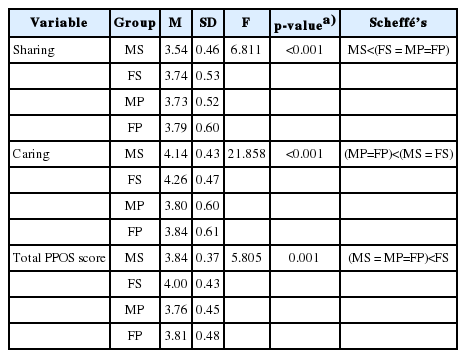
Differences between Male and Female Students’ and Patients’ PPOS Scores
Discussion
Patients often wish to obtain diverse information during healthcare and discuss their illnesses and treatment with doctors [13]. In addition, patients typically give positive evaluations for doctors who can empathize [14]. As such, Anglo-American medical education institutions treat education of patient-centred attitude very seriously [15,16,17].
We attempted to identify the gap in perceptions of medical students’ patient-centred attitudes between patients and medical students themselves, and to discuss what medical education must focus on in order to create effective doctor-patient relationships. Our results showed that Korean medical students had higher PPOS scores than did patients. This is in contrast to Kim’s study [18], wherein patients’ scores were higher than were those of physicians. These conflicting results suggest that when medical students graduate, their patient-centred attitude may decrease. In addition, although Korean medical students’ mean PPOS total score was 3.90 (maximum score, 6), which was higher than the patients’ (3.79), the mean total scores of medical students from nine U.S. medical schools in a previous study were significantly higher (4.76-4.84) [19]. Such results suggest that there may be challenges in creating effective programs for Korean medical students that both enhance patient-centred attitude and maintain it after graduation. However, our findings provide suggestions of how to establish such educational programs.
Some of those suggestions are as follows. First, there were clear gaps in perceptions of medical students’ patient-centred attitude between medical students and patients. Students saw themselves as having better patient-centred attitudes and care than did patients, whereas patients believed students to be better at sharing information and decision-making than did students themselves. This latter result is perhaps because patients’ need for information sharing and to be included in the decision-making process in patient care is much higher than what students typically believe. Specifically, patients desire the responsibility and decision-making capability for their own healthcare and treatment, and want to feel able to provide their own viewpoints during treatment as an equal partner with the doctors. Indeed, patients’ scores for survey items concerning respect and trust for the doctors indicated greater doctor-centeredness than did the scores of students.
On the other hand, students believed that they treated patients more holistically and placed more emphasis on patients’ expectations and feelings than what patients believed. This indicates another clear perception gap in the doctor-patient relationship. The most effective healthcare treatment outcomes and highest patient satisfaction with medical treatment typically occur when perceptions of sharing and caring coincide within the principal agents-namely, doctors and patients [20]. Thus, educational programs regarding the subject should include a specific goal to reduce the perception gap between patients and medical students. Second, significant gender gaps were found in patient-centred attitude, which should be considered in developing related programs. Particularly, the male student group should be provided with a tailored program aiming to enhance “sharing” values in patient care. Furthermore, programs focus on improving students’ attention to patients’ gender, personality traits, and healthcare needs. To do this, communication skills training must be emphasized to a greater degree. Specifically, skills in gathering and sharing information, explanation planning, and reaching consensus on problems and approaches to solve such problems should be promoted in programs designed to reinforce doctors’ “sharing” competency in patient care. Through such educational programs, medical students can become good doctors who can provide diverse information to patients and allow them to be actively involved in decision-making.
Changes in current instructional methods for medical students are also needed. One-way class lectures should be discouraged, whereas clerkships that can provide sufficient exposure to highly realistic clinical situations, necessary skills, actual practice, structured feedback, etc. should be provided using an integrated approach. Furthermore, new methods of improving medical students’ communication skills are continually being developed, such as using standardized patient interviews and video feedback [21], or using telephone follow-up training [22]. These examples suggest that providing sufficient opportunity for actual training is essential. Additionally, apart from a formal educational curriculum, hidden curricula [19,23] and learning motivation [24] should be considered to optimize the educational outcome.
This study identified the perception gap in medical students’ patient-centred attitude between patients and medical students, and suggested that reducing the perception gap should be the main focus of the patient-centred care education programs for medical students. Suggestions for further studies are as follows: first, this study used accumulated data from 2005 to 2010 but did not consider the possibility of distinct tendencies of patient-centred attitude in different periods. A further study on how patient-centred attitudes change with time could be meaningful. Second, this study identified the existence of a gap in perception between patients and medical students but did not examine the reason for this gap. Identifying the various elements that affect the perception gap in the patient-centred attitude of medical students will help in developing a more sophisticated program on the subject.
Acknowledgements
None.
Notes
Funding
None.
Conflicts of interest
None.